 Tetrate Service BridgeVersion: next
Onboard a Cluster
Once you have downloaded and configured tctl, the next step is to onboard a new workload cluster to your TSB installation.
Before You Begin
Ensure the following tools are available:
kubectlhelm
Set a variable with your chosen cluster name — it will be referenced throughout the steps below:
export CLUSTER_NAME=<cluster-name>
Cluster Prerequisites
- AWS EKS
- Azure AKS
- Google GCP
Tetrate recommends installing AWS Load Balancer Controller on each workload cluster.
For high-volume or production usage, establish a PrivateLink connection to reduce cross-region egress costs to the hosted Management Plane. Please contact Tetrate support to set this up.
There are no prerequisites for Azure AKS clusters.
There are no prerequisites for Google GCP clusters.
Onboard the Cluster
Add the Tetrate Helm Repository
helm repo add tetrate-tsb-helm 'https://charts.dl.tetrate.io/public/helm/charts/'
helm repo update
Register the Cluster and Generate Defaults
Create the cluster object in TSB, then generate the default Helm values. The defaults file contains the connection details and credentials derived from your Management Plane:
tctl apply -f - <<EOF
apiVersion: api.tsb.tetrate.io/v2
kind: Cluster
metadata:
  name: ${CLUSTER_NAME}
  organization: <ORGANIZATION>
spec: {}
EOF

tctl x cluster-install-template ${CLUSTER_NAME} > ${CLUSTER_NAME}-defaults.yaml
Create the Values Override File
Create a
${CLUSTER_NAME}-values.yamlfile with the configuration required for the Hosted management plane:${CLUSTER_NAME}-values.yamlspec:
components:
internalCertProvider:
tsbManaged: {}
spmAgent:
enabled: true
meshObservability:
settings:
apiEndpointMetricsEnabled: trueAmbient ModeTo enable Istio ambient mode, add the following to the
componentssection:istio:
ambient:
enable: trueInstall the Tetrate Control Plane
helm upgrade --install controlplane tetrate-tsb-helm/controlplane \
  --namespace istio-system --create-namespace \
  --timeout 10m \
  --values ${CLUSTER_NAME}-defaults.yaml \
  --values ${CLUSTER_NAME}-values.yaml
Validate the Installation
Check that all components are running:
kubectl get pods -n istio-systemVerify the cluster appears in TSB:
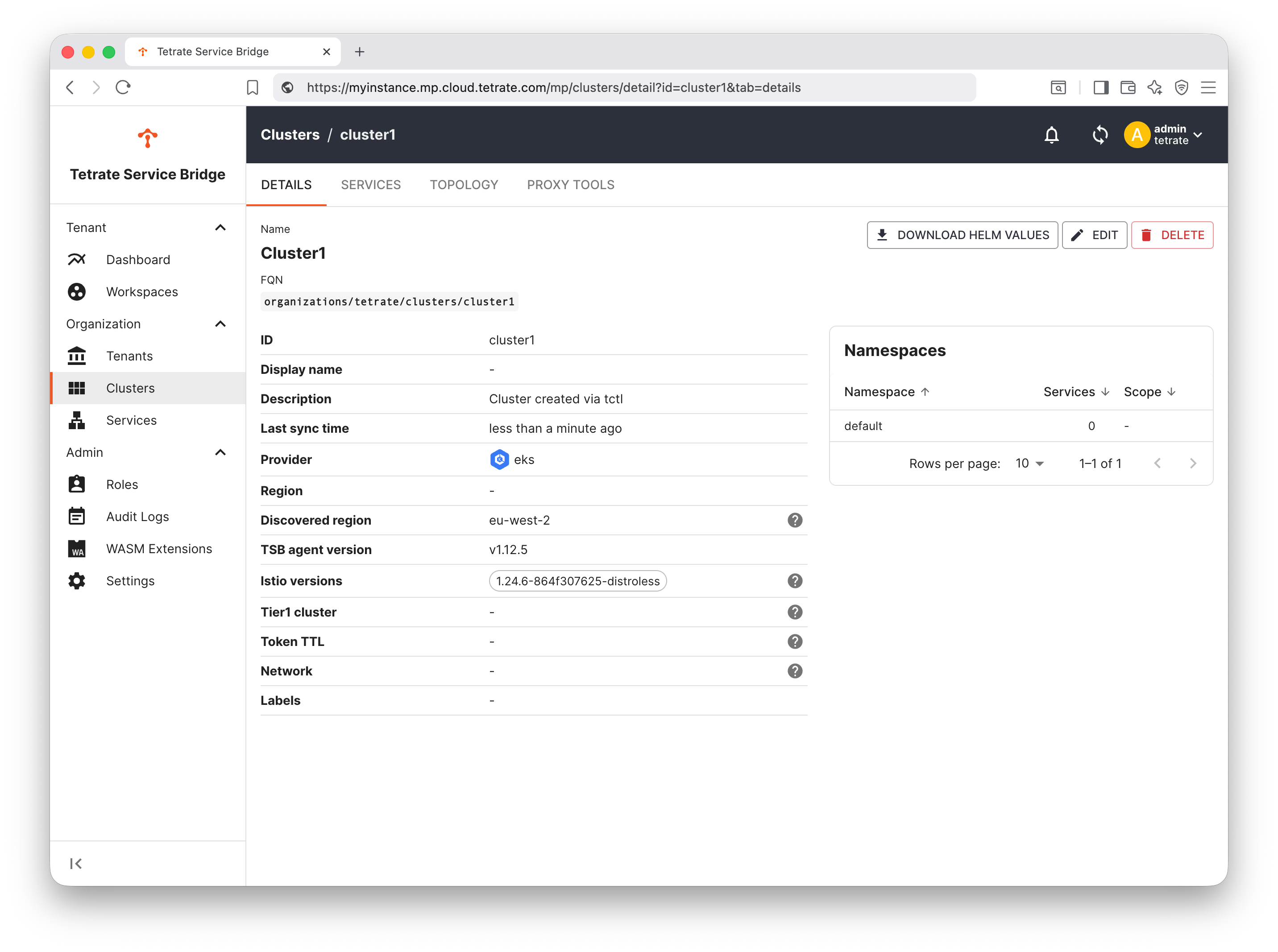
tctl get clusterYour cluster status can also be viewed in the TSB UI:
Next steps
Once your cluster is onboarded you may wish to:
- Proceed with the Getting Started examples.
- Install the Tetrate Hosted Agent to expose services through annotation-driven gateway configuration.